

Practical answers for serious hire businesses.
Hyraventa is built for companies that need stronger operational control across quoting, assets, dispatch, returns, compliance, paperwork, invoicing, accounts package links, payment collection, and the web-facing content that supports sales. These are the questions owners, teams, and technical stakeholders usually ask first.
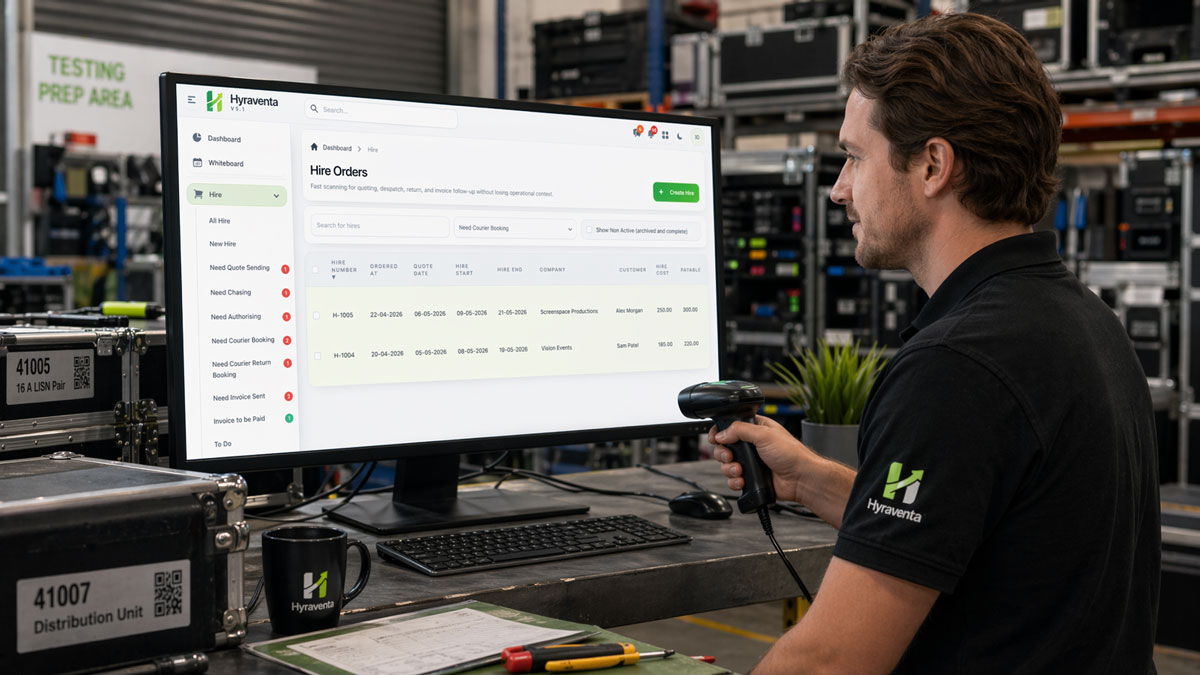
The short version.
If you want the commercial summary before the detail, start here.
What is Hyraventa?
Hyraventa is a purpose-built rental and hire operations platform for equipment businesses that need tighter control over quoting, assets, dispatch, returns, compliance, paperwork, purchasing, invoicing, accounts package links, payment collection, and related website content.
Who is it for?
It is designed for companies hiring out tools, instruments, test equipment, AV kit, event kit, specialist assets, and mixed fleets of serialised items plus stock or consumables.
What makes it different?
It is built around real operational workflow, not just contacts, stock lists, or generic job records. It is especially strong where availability, traceability, compliance, and cross-team coordination actually matter.
Commercial answers for people responsible for growth, control, and margin.
These questions usually come from founders, owners, directors, and senior operators.
What problem does Hyraventa solve at a business level?
It helps replace fragmented operational work across quotes, orders, assets, dispatch, returns, compliance, paperwork, invoicing, and internal communication with one joined-up operating system. That reduces avoidable mistakes, protects margin, improves accountability, and gives management a clearer live view of the business.
Is this just another stock system or CRM?
No. Hyraventa is stronger than a stock list and more operationally useful than a generic CRM. It understands booked assets, overlapping demand, returns, despatch flow, paperwork, multiple contact roles, compliance states, and the real coordination needed between desk, warehouse, service, and finance.
How does Hyraventa help protect revenue and margin?
It reduces quoting delays, prevents the wrong assets being promised, improves dispatch accuracy, shortens the gap between work done and invoicing, gives earlier visibility of shortages, and helps teams recover assets and paperwork properly. That protects both revenue and operating discipline.
Can it support both hire and sales?
Yes. Hyraventa supports hire workflow, sales workflow, and lab hire workflow. That matters for businesses that rent some items, sell others, and need those activities connected rather than split across separate tools and spreadsheets.
Will it work for a business with serialised, compliance-sensitive assets?
Yes. That is one of its strongest use cases. Hyraventa is especially valuable where the operation depends on serial numbers, booked assets, calibration dates, PAT dates, verification, inspection, service status, and clear traceability over what is safe and ready to send.
Can Hyraventa support the website as well as internal operations?
Yes, carefully and in the right way. Hyraventa supports website-connected product and category content, images, meta data, and related web-facing information. The value is that the operational system and the commercial web layer do not have to drift apart.
Does the website stay in sync with Hyraventa?
That is the intention. Hyraventa can hold and manage the web-facing content and asset data that supports the website, so the business is not manually copying the same information into multiple places. That reduces duplication and helps keep website content aligned with operational reality.
Where does AI fit in?
AI is used selectively for practical support tasks, not vague gimmicks. A good example is helping generate or assist with SEO metadata, web content support, alt text, and similar admin-heavy content tasks where speed matters but human control still matters as well.
Is it suitable for a smaller but serious operator?
Yes. Hyraventa is not built only for large enterprise businesses. It is a strong fit for smaller teams that have real operational complexity and have already outgrown spreadsheets, shared inboxes, or generic systems.
Why not just keep using spreadsheets and accounting software?
Because those tools do not give a safe live operating record across quotes, booked assets, returns, compliance status, dispatch flow, and multi-team coordination. The cost of staying with patched-together systems is usually hidden in mistakes, delays, duplicated work, and weak visibility.
Questions from hire desk, warehouse, service, admin, and finance teams.
These are the practical workflow questions teams usually ask when they are thinking about using Hyraventa every day.
Can the hire desk quote quickly without rebuilding the same information?
Yes. Hyraventa is designed to reduce rekeying by taking quotes through to live orders with the commercial and operational detail still attached. That means less repetition, fewer manual errors, and faster turnaround from enquiry to confirmed work.
Can we handle flexible dates, indicative hires, and extensions?
Yes. Hyraventa supports flex dates, indicative periods, hire extensions, quote-to-order changes, and moving records back when needed. It is built for the reality that hire work changes, and the system needs to cope with that without creating chaos.
Can warehouse teams see exactly what needs picking and sending?
Yes. Hyraventa includes despatch workflow, pick state handling, paperwork generation, courier details, timestamps, and a clearer operational record for the warehouse. The aim is to reduce confusion and help despatch happen with stronger control.
Does it help with returns properly?
Yes. Hyraventa includes a dedicated returns workflow with returned status handling, receive confirmation, line-level controls, timestamps, and related actions. That helps businesses close the loop properly instead of letting assets disappear into limbo.
Can we see if something is actually available and compliant before promising it?
Yes. Availability logic checks more than whether an item exists. It also considers bookings, reservations, overlaps, and operational or compliance states such as calibration expiry, PAT expiry, service, inspection, repair, quarantine, and BER.
Can service or calibration teams track compliance-related work?
Yes. Hyraventa tracks compliance-related data at asset level, including calibration, verification, PAT-related dates, service-related states, files, comments, and related history. That makes it easier to see what is safe, what is due, and what is blocked.
Can finance and admin teams manage invoicing more cleanly?
Yes. Hyraventa supports invoice sent and paid states, due dates, overdue logic, credit notes, invoice comments, and related commercial controls. The value is not just record keeping, but faster invoicing and clearer follow-up.
Can Hyraventa link up with accounts packages like QuickBooks?
Yes. Hyraventa can support links with accounts packages such as QuickBooks so invoice and finance-related data does not have to be manually rekeyed from the hire operation into the accounts process. The aim is to keep operational control in Hyraventa while giving finance a cleaner route into the accounts package.
Can customers pay through payment gateways like Stripe?
Yes. Hyraventa can support payment collection through gateways such as Stripe, helping customers pay more easily and keeping payment status closer to the order and invoice workflow. That gives teams better visibility over what has been sent, what has been paid, and what still needs chasing.
Can customer, billing, and shipping details all live in the same place?
Yes. Hyraventa supports company records, person records, multiple contact roles, address handling, billing and shipping detail selection, and on-the-fly address creation during workflow. That reduces duplication and avoids important details being scattered.
Can we keep notes and communication attached to the right record?
Yes. Hyraventa supports CRM comments, order comments, invoice comments, internal notes, asset comments, notifications, and related workflows. That helps keep context where it belongs instead of buried in inboxes or memory.
Can managers and teams see what is coming up this week?
Yes. The whiteboard and planning view surfaces hires, sales, events, despatch activity, returns, and operational scheduling in one place. It is best understood as an operations control tower rather than just a calendar.
Questions about rollout, data, integration, security, and web-connected operation.
These are the questions that usually come from technical leads, implementation stakeholders, or people responsible for rollout risk.
How difficult is implementation?
That depends on data quality, process complexity, migration needs, and how much operational shaping is required. Simpler businesses can move faster. More involved environments usually need a more structured rollout. The implementation should reflect the business, not force the business into a rushed template.
Can Hyraventa handle messy real-world data?
Yes, within reason. Most operational businesses do not have perfect legacy data. Implementation typically involves reviewing customer records, addresses, assets, stock, and related structures so the system starts from a cleaner position than the business had before.
Does it support multi-user working safely?
Yes. Hyraventa includes team-safe editing checks in relevant save flows so one user does not silently overwrite another user’s changes. That is important in busy operational environments where multiple people may be active on the same records.
What does security and access control look like?
Hyraventa supports authenticated access, verified users, team-based structure, two-factor authentication, restricted sections, admin-only areas, and API capability through the underlying stack. It should be understood as business-grade access control, not lightweight consumer software.
Can it support integrations or API-led work?
The platform stack supports API token capability and structured operational data. The right integration approach depends on what needs to connect, how tightly, and which workflows actually need to be kept in sync.
How do accounts and payment integrations fit into the workflow?
They are there to reduce friction around finance, not replace the operational system. Hyraventa keeps the hire workflow, assets, paperwork, invoice state, and customer context together, then can connect relevant finance or payment activity to systems such as QuickBooks or Stripe where appropriate.
How does Hyraventa support website-linked product and content operations?
Hyraventa includes website-related product and category support such as web category, web image, web meta, related content, specification panels, and page/editor-related services. That means the operational system can support the catalogue and content layer without being positioned as a generic ecommerce suite.
Can the website stay aligned with live business data?
Yes, that is one of the important commercial advantages. Instead of maintaining separate operational truth and website truth, Hyraventa can help keep website-facing product and content data connected to the same working records, reducing drift and duplicated admin.
Can images and web assets be managed inside Hyraventa?
Yes. Hyraventa supports web-related image and content handling as part of the broader product and category record structure. That makes it easier to manage sales-supporting content in the same place as the operational source data.
Where is AI used in the website and content workflow?
AI is best used as practical assistance, not as a replacement for operational judgement. Examples include support with SEO meta descriptions, alt text, draft content, and similar repetitive content tasks where speed and consistency matter.
Is Hyraventa trying to replace every other system in the business?
No. The goal is not to pretend every business tool disappears. The goal is to put the core rental and hire operation, its records, its control points, and its web-connected commercial content in a much stronger, more joined-up position.
The sensible concerns most buyers raise.
If you are comparing Hyraventa with your current process, these are usually the real questions underneath the conversation.
We already use spreadsheets.
That is common. The issue is not whether spreadsheets can hold data. It is whether they can safely run live quote-to-order workflow, booked assets, returns, compliance logic, multi-user editing, despatch control, and joined-up operational accountability without creating risk.
We already have a CRM.
A CRM can be useful for contacts and notes, but it usually does not understand operational rental workflow at asset level. It does not naturally handle booked serialised assets, compliance-sensitive availability, despatch and return control, or the warehouse-service-finance reality of hire businesses.
Our process is a bit unusual.
That is exactly why generic tools often start to fail. Hyraventa is most valuable where the operation has real-world complexity, whether that is lab hire, mixed hire-and-sales, compliance-heavy assets, multiple address roles, or stronger planning needs.
We are worried implementation will be disruptive.
A careless implementation is disruptive. A properly scoped one reduces disruption over time by replacing repeated manual work, hidden workarounds, and fragile process gaps with a clearer operating model.
We are not a huge team.
That can actually make stronger operational software more valuable. Smaller teams usually feel process weakness faster because fewer people are carrying more responsibility, and operational knowledge is concentrated in fewer heads.
We already use accounting software.
That is normal. Accounting software is not the same thing as rental operations control. Hyraventa is concerned with quoting, booked assets, despatch, returns, compliance, paperwork, commercial workflow, payments, and the operational record that exists before finance reporting is finished. Where useful, it can link with accounts packages like QuickBooks instead of asking the business to rekey everything by hand.
The fastest way to judge Hyraventa is against your real workflow.
The useful conversation is not about generic features. It is about how your team currently handles quoting, asset availability, despatch, returns, compliance, invoicing, and website-connected content, and where the current process is creating drag or risk.